Flower/Plants, Derivative Products, and Edibles
11 cannabinoids
LCUV
Cannabis and hemp brands can access expanded cannabinoid potency testing panels with ACS. Using gold-standard LCUV and LCMS methods, our team provides accurate results for major cannabinoids and a wide range of minors. These panels help cultivators, manufacturers, and MMTCs refine formulations, evaluate cultivar performance, and prepare products for every market.
The expanded Potency 13 panel is ideal for research and development (R&D), covering THC, CBD, and nine core minors like CBG, CBC, Δ8, and Δ10. Nationwide hemp operators may also choose the National Hemp Compliance panel, which includes 39 cannabinoids and 11 additional minors for those who sell in Colorado. This cannabinoid LCMS panel satisfies the strictest potency testing rules in the country.
Flowers / Biomass / Derivatives / Edibles
13 Count
LCUV
Flowers/Plants, Derivative Products, and Edibles
39 - 50 cannabinoids
LCUV
Hemp brands producing HHC products need more than a standard potency test. HHC comes with stereoisomers, metabolites, and analogs that influence how it performs and how it’s regulated. A dedicated HHC potency testing panel captures those compounds to give brands clear answers for R&D and compliance.
ACS Laboratory’s specialized HHC panel profiles nine derivatives and includes a compliance check for Δ9-THC to confirm products stay within regulatory limits (below 0.3%). Results support consumer safety, marketing efforts, and retailer acceptance. An optional HHC heavy metals add-on is also available for safety assurance.
Flowers / Biomass / Derivatives / Edibles
9 cannabinoids
LCUV

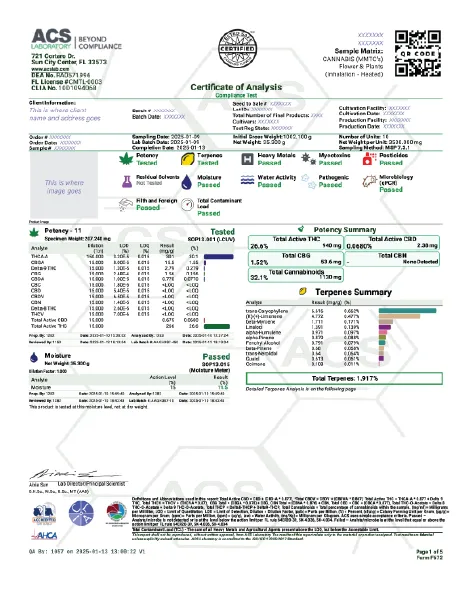
Every sample comes with a Certificate of Analysis (COA) proving your product passed cannabinoid label accuracy testing. ACS Laboratory’s COAs include pass/fail status, quantitative data, and formatting that matches state requirements. A built-in QR code links every batch to its verified results, so regulators, retailers, and consumers can instantly confirm safety.
Verifying that potency claims match your packaging prevents costly recalls and strengthens your brand’s reputation. It also educates consumers so they have the best possible experience.
ACS Laboratory tests potency in a wide range of matrices, including cannabis flower, hemp biomass, concentrates, edibles, tinctures, topicals, and beverages. Each product type has a validated method to ensure accurate results and compliant COAs.
Cannabinoid label accuracy testing helps you compare COA data to the values displayed on your product packaging. If a label claims 25 mg of CBD or 1 mg of Δ9-THC per serving, ACS Laboratory verifies those numbers through precise analysis. Matching results prevent costly recalls, protect consumers, and maintain retailer acceptance.
ACS Laboratory’s HHC potency testing panel profiles nine cannabinoids, including (9R)-HHC, (9S)-HHC, HHCP isomers, hydroxy-HHC, H4-CBD stereoisomers, H2-CBD, and Δ9-THC. Results confirm potency, safety, and regulatory compliance for hemp-derived HHC products.
The right panel depends on your goal. The Florida potency 11-panel fulfills OMMU compliance for MMTCs. The R&D Potency 13 panel supports product development with added minors like ∆6a10a-THC and Δ10. The National Hemp Potency panel covers 39–50 cannabinoids for multi-state brands that must meet the strictest rules. The HHC Potency 9 panel targets hemp-derived products with HHC derivatives and includes a Δ9-THC check.
Florida’s Office of Medical Marijuana Use requires MMTCs to test for 11 cannabinoids, including Δ9-THC, Δ8-THC, CBD, CBG, CBC, and their acidic precursors. ACS Laboratory performs this full Florida OMMU 11-panel potency method using LCUV instrumentation and provides COAs formatted to state standards.