Nano cannabis edibles can act faster and hit harder than traditional edibles. However, not all nanoformulations deliver on that promise. Studies show that only some nanoformulations achieve faster absorption and higher bioavailability than conventional edibles. The evidence more consistently supports earlier cannabinoid absorption than it supports claims of a universally faster onset or stronger effects.
H2: What Are Nano Edibles?
Nano edibles are THC-infused foods and beverages made with nanoemulsion technology. The nanoemulsion process breaks down cannabinoids such as THC and CBD into microscopic oil droplets that disperse evenly throughout the mixture. Because standard nano-emulsions remain free-flowing liquids, your body can absorb the exposed cannabinoids almost instantly through your mouth and stomach lining.
The goal of nano-emulsified cannabinoids is to enhance the edibles experience with more speed, strength, and predictability.
Reported nano-edible benefits include:
faster onset (you feel the effects more quickly)
increased absorption of cannabinoids (your body gets more THC into the bloodstream)
shorter overall psychoactive experience (the high wears off faster than regular edibles)
more predictable peak effects (you know when to expect the strongest high)
How do you make nano edibles?
Manufacturers typically use mechanical or chemical methods to break down cannabinoid oils into droplets roughly 20-200 nanometers in diameter. They distribute the tiny droplets evenly throughout a liquid or gel base.
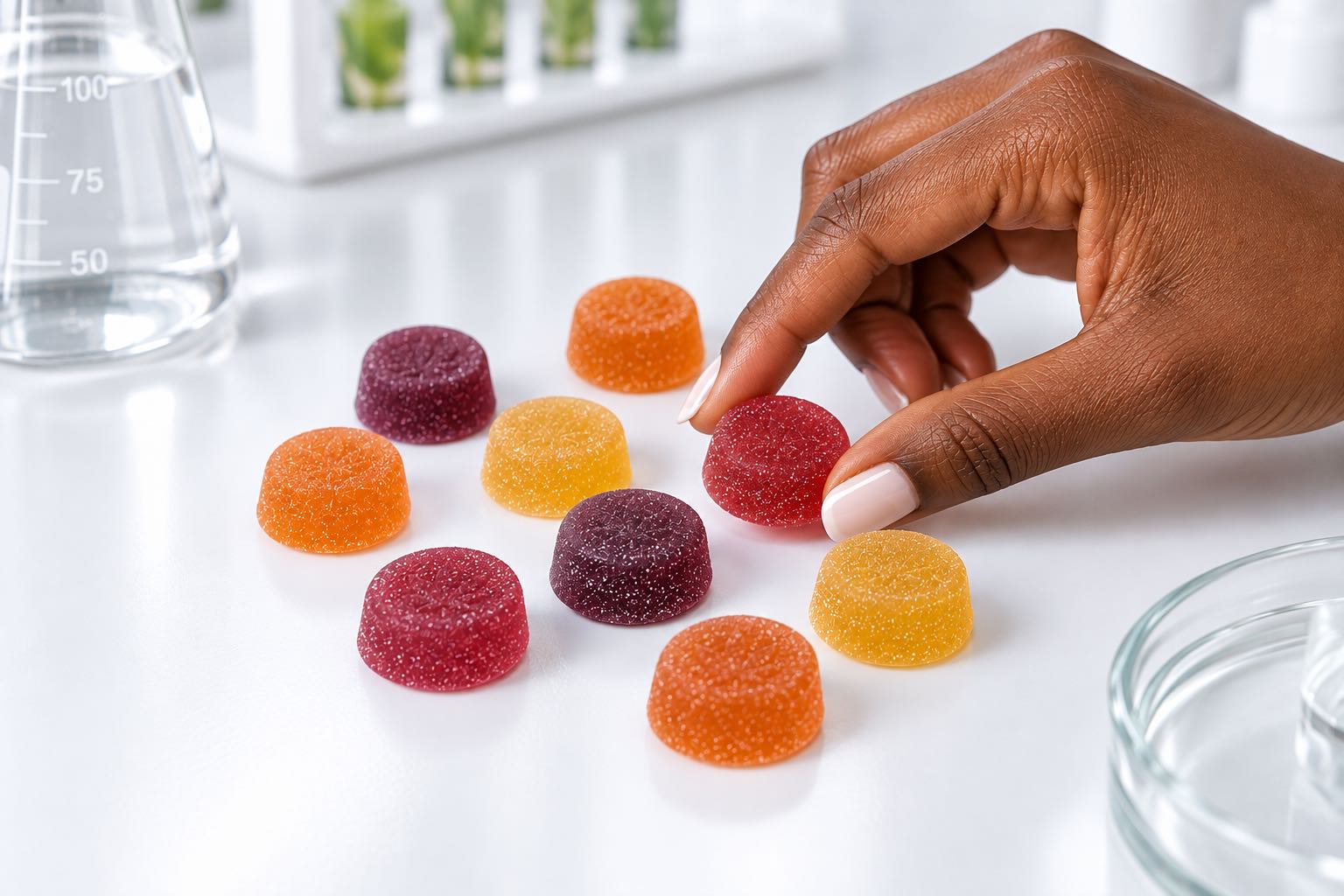
In solid edibles like gummies, manufacturers combine the nanoemulsion with the gelatinous mixture before it sets. Once the gelatin or pectin solidifies, the cannabinoid particles remain evenly distributed rather than concentrated in pockets, like traditional edibles.
How do you make regular edibles?
Manufacturers make regular edibles by dissolving cannabinoid extracts in oil or fat and mixing the infusion directly into the edible base. Unlike nano edibles, the process does not break the cannabinoid oil into microscopic droplets before adding it to the product.
In solid edibles like gummies, manufacturers blend the cannabinoid-infused oil directly into the gelatin or pectin mixture before it sets. The cannabinoids remain suspended in larger oil droplets throughout the finished gummy rather than dispersed as submicron droplets.
H2: Why Do Traditional Edibles Take Longer to Work Than Nano Edibles?
Traditional edibles can take longer to kick in (onset at 30–60 min) and last longer (peak at 1.5–3 hrs) because the body has to work harder to break down the larger oil droplets before the THC can reach the brain and take effect. Other reasons for the delay include poor water solubility, slower digestion, and delayed liver metabolism. (source)
Here’s why traditional edibles take longer to work than nano edibles:
1. Poor water solubility
Traditional edibles suspend THC and CBD in relatively large oil droplets that do not mix well with the water-based environment of the digestive tract.
Nanoemulsions reduce those droplets to microscopic sizes, allowing them to disperse more readily into the intestines.
2. Slower digestion
The stomach and small intestines have a harder time digesting the larger oil droplets and complex food matrices found in traditional edibles because the system must physically break them down first.
Nano gummies are already reduced to submicron droplets, so there's little to no breakdown required.
3. First pass metabolism leads to further delays
Once THC crosses the gut (intestinal) lining, it travels directly to the liver for first-pass metabolism. Here, the THC is converted to 11-hydroxy-THC before it reaches the brain and other tissues. This delays the onset time and destroys most of the dose. Only about 6% to 10% Delta9-THC reaches systemic circulation in standard edibles. (repeated source)
Nanoemulsions partially bypass the liver's first-pass metabolism and are highly bioavailable. Studies show that a self-nanoemulsifying powder formulation achieved 2.9 times higher relative bioavailability for THC compared to standard oil drops. (source)
H2: Do Nano Edibles Actually Work as They Claim? (looking at the research)
The pharmacokinetic data for nanoemulsion formulations show that they kick in and reach peak THC concentration faster and that the body absorbs more THC than standard edibles. (repeated source) But whether that translates to a better, stronger high is unproven in scientific research.
What the studies show
1. Faster absorption and earlier peak THC levels:
A 2026 crossover study gave 20 participants a fast-acting edible, a standard edible, and a placebo. The fast-acting product reached peak plasma concentrations at 30 minutes, about 30 minutes earlier than the standard edible. However, total exposure and peak concentration did not significantly differ between the two THC products. The technology involved microencapsulation (a type of nanoemulsion), but it does not directly validate every nanoemulsion product. (source)
2. Higher cannabinoid exposure and faster absorption:
A 2025 crossover study compared a self-nanoemulsifying THC/CBD powder with oil drops in 14 healthy adults. The nano-enabled powder produced substantially higher peak THC concentrations and more than doubled relative cannabinoid bioavailability. Several metabolites also reached peak concentrations much sooner. (repeated source)
3. Improved pharmacokinetics compared with oil:
A randomized, triple-blind study of 32 adults compared an oral delivery system called Solutech with MCT-based cannabis oil. The novel formulation produced faster peak times, higher maximum concentrations, and faster absorption across THC, CBD, and their metabolites. The study suggested improved bioavailability, although participants' cannabis-use history also affected the results. (source)
H2: Does Faster Absorption Mean Stronger Effects?
No study has directly measured subjective effects (how high you actually feel) from a nanoemulsified edible compared to a traditional edible. Everything we know about the actual high comes from non-comparative studies on traditional edibles.
Most nano studies measured pharmacokinetics (lab measurements) rather than assessing subjective intoxication (personal experiences), functional impairment, or duration of effects.
A faster THC blood concentration peak in nanoedibles may suggest faster onset, but it does not automatically prove that every consumer will feel effects within 10, 15, or 20 minutes.
The available studies also test specific proprietary formulations. They do not prove that all products marketed as “nano,” “water-soluble,” or “fast-acting” perform the same way.
Droplet size, ingredients, dose, manufacturing quality, food intake, and individual metabolism can all change performance.
TLDR: Nano edibles measurably deliver more cannabinoids into your blood faster. However, no published trial confirms that this mechanism makes the nano high hit any faster or stronger.
Nano Edibles Claim
Evidence
Faster onset
Supported for some formulations
Stronger high
Limited evidence
More THC absorbed
Some evidence
Same experience for everyone
False
What Do Reviewers Say?
Based on user reports across these subreddits, the consensus is that, yes, nano-emulsions genuinely work faster and feel stronger, but there are important caveats and quality differences to keep in mind.
Faster Onset & High Potency:
A patient in r/PaMedicalMarijuana shared that taking a 25 mg nano capsule felt significantly stronger:
"I took a 25mg capsule and I thought I was on 50mg+… I was having some pretty screwy existential thoughts." — paulrudder
Direct Experience from Manufacturers:
Industry workers in the thread back up these claims:
"The affects hit with in minutes and the high is a bit stronger." — PrettyyTragedyy
A Solution for Edible "Non-Responders":
Multiple commenters noted that nano-emulsions worked for them even when traditional edibles or RSO completely failed:
"I can eat full syringes of distillate or rso with nothing no effects but this nano stuff smacks me... strongest edible experience I've had hands down" — BasicFig8
What Are the Caveats & Is It Hype?
While users agree the technology works, they emphasize that not every product labeled "nano" is legitimate, and the metabolic pathway alters the type of high you get:
In r/trees, users warned that many products on the market misuse the term:
"So, nano is a tricky topic. Some are real, some aren't... some are just "nano emulsified" which means they were exposed to something like an ultrasonic homogenizer, but didn't actually go through the particle size reduction phase. Or they don't have anything to allow the material to remain in a nano scale." — gidgetsflow
They also point out that manufacturing heat can ruin the nano-structure before it ever reaches the shelf:
"The other thing is surfactants, some are better than others at achieving smaller particle sizes, but aren't heat stable. You use those in candy and you'll lose your nano particles before the water in your candy boils." — gidgetsflow
2. Different Type of High (Not the Classic Edible High)
Because nano-THC is absorbed rapidly through mucosal membranes or directly into the bloodstream without initial liver conversion, several users note it feels more like smoking or vaping than a standard edible:
"[Nano] doesn’t feel like 11-Hydroxi the way normal edibles do, if you eat nano disty it feels like you hit a disty cart not like you ate an edible." — Normal-Spell5339
"Sublingual/buccal avoid the liver by passing directly into the blood... Bonus is since it never hits the liver it is delivered as d9 to the blood/brain barrier and not 11-OH d9." — C_Everett_Marm
H2: Can Lab Testing Verify Nano Edible Claims?
Third-party laboratory testing cannot confirm that a nano edible will kick in within 10 minutes or produce a stronger high. However, potency testing edibles is essential for verifying that the product actually contains the THC levels it claims and delivers a consistent formula.
Testing can help manufacturers verify:
Potency: Cannabinoid testing measures THC, CBD, and other cannabinoids to confirm the finished product contains the intended dose.
Homogeneity: Testing edible samples from across a batch for homogeneity can determine whether cannabinoids are distributed consistently rather than concentrated in certain portions.
Contaminant Screening: Contaminant testing can screen finished edibles for pesticides, heavy metals, residual solvents, microbes, and other potential hazards.
Product consistency: Testing batches over time helps manufacturers identify changes in potency or formulation that could affect product quality.
H2: Frequently Asked Questions
Are nano edibles stronger than regular edibles?
Not necessarily. Nano formulations increase THC absorption and blood concentrations compared with conventional oil formulations. However, research has not established that nano edibles consistently produce a stronger subjective high. Some people compare the high to smoking a vape rather than a traditional edible, known for its intensity.
How fast do nano THC gummies work compared to regular gummies?
Some may begin working in about 10 to 20 minutes, but there is no universal onset time. Conventional edibles commonly take about 30 to 60 minutes to produce noticeable effects, and sometimes longer.
Are nano edibles good for beginners?
They can be used by beginners, but they are not automatically milder or easier to dose. A faster onset may help some consumers avoid taking additional THC before the first dose takes effect. However, the effects may still intensify after the initial onset and can last for several hours.
Beginners should start with the labeled serving size, avoid taking more THC too soon, and follow applicable low-dose guidance. A nano label does not eliminate the risk of overconsumption.
Do nano CBD gummies absorb better?
Some do, but not all. Human and formulation studies have found that certain nanoemulsions and self-nanoemulsifying CBD products can increase CBD absorption or bioavailability compared with conventional oil formulations. The result depends on the specific particle size, surfactants, carrier oils, dose, and manufacturing process. The word “nano” alone does not prove improved absorption.
What is the difference between sativa and indica nano edibles?
Nano describes the delivery system; sativa and indica describe cannabis classification or marketing categories. Nanoemulsion technology involves formulating cannabinoids for absorption. Sativa and indica labels do not determine particle size, absorption rate, onset time, or effect intensity. The cannabinoid profile, terpene content, dose, and individual response are more relevant to the product’s effects than the sativa or indica label alone.
Need a Test or Have a Question
Call Us at 813-670-9197 or Click to send us a message.












.png)


.png)
.png)
.png)
.png)

