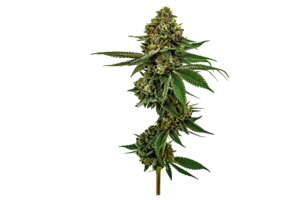
Hemp testing is essential at every stage of production, from preparing soil for planting to verifying the quality and potency of finished products. Each stage requires different tests to identify contaminants, protect product quality, and meet applicable regulations.
This 2026 hemp testing timeline outlines what growers and manufacturers should test, when to test, and how evolving federal and state requirements affect compliance.
Key Takeaways
The best hemp testing timeline includes compliance and quality tests that run from pre-planting soil analysis through post-production testing of finished goods.
USDA rules require a pre-harvest total THC test within 30 days of harvest, at or below 0.3% on a dry weight basis.
A new federal hemp definition also requires finished product testing and caps total THC at 0.4 milligrams per container.
State rules and federal rules set the minimum testing standards. Quality-focused testing at every stage protects crops, products, and consumers.
When and What to Test, in Brief
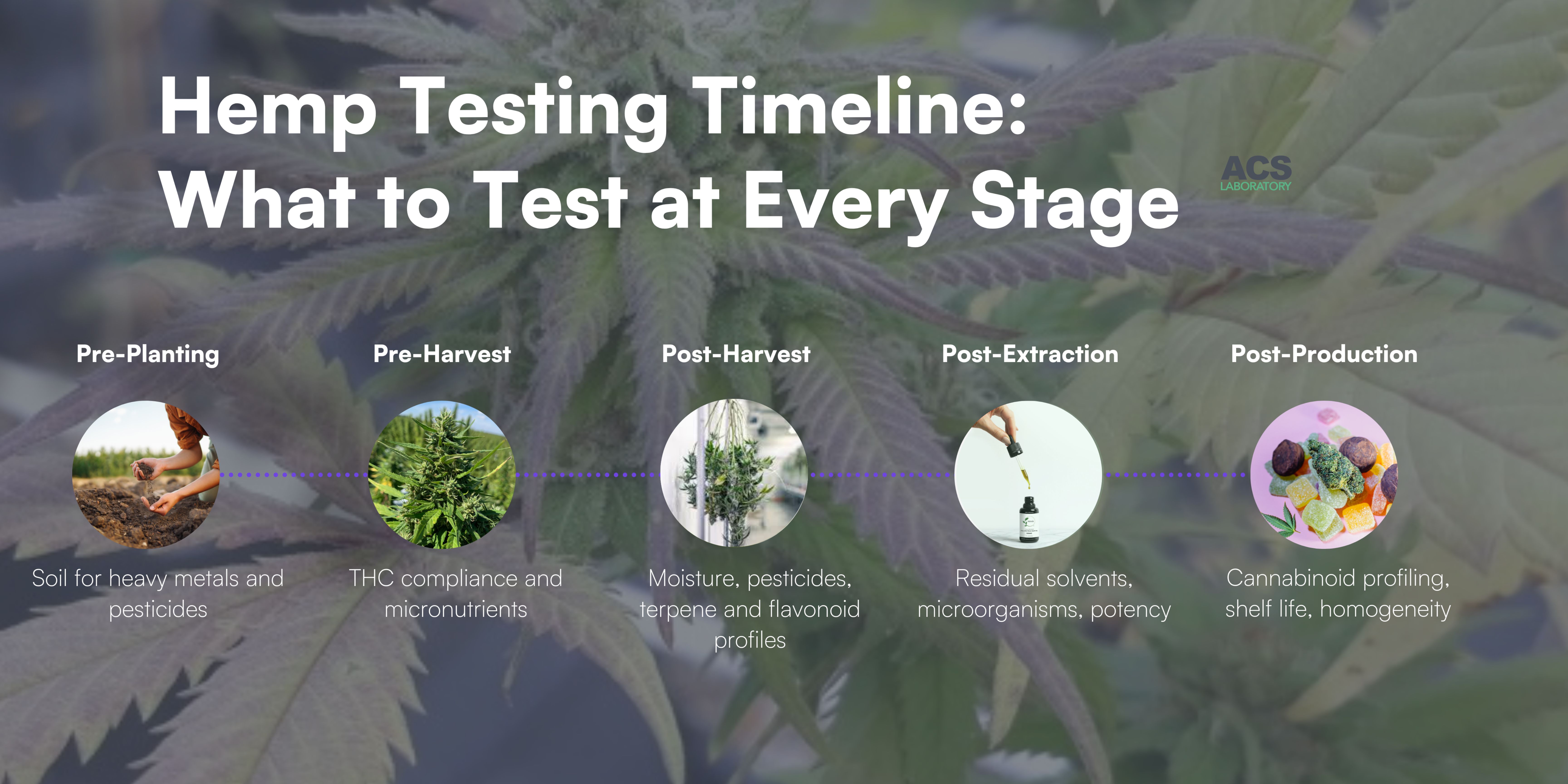
Hemp growers and producers should conduct third-party testing for compliance and quality at five stages. These are:
Federal and state hemp testing regulations shape part of this timeline. Consumer demands for pure and potent products shape the rest.
Federal Hemp Testing Rules
USDA Pre-Harvest Testing
The USDA 2021 Final Rule for the Domestic Production of Hemp sets the federal standard for pre-harvest testing. Growers must have samples collected within 30 days before harvest. Total THC can’t exceed 0.3% on a dry weight basis.
Labs measure total THC by combining delta-9 tetrahydrocannabinol (THC) with tetrahydrocannabinolic acid (THCA). THCA converts to THC when heated, so the rule counts both. Third-party hemp labs must also calculate and report measurement uncertainty with each result.
A crop that tests above 0.3% total THC is non-compliant. Growers may remediate or dispose of it under USDA-approved methods.
DEA Lab Registration
The Final Rule requires compliance testing at laboratories, such as ACS Laboratory, that are registered with the Drug Enforcement Administration (DEA). The USDA has delayed enforcement of this requirement until December 31, 2026, citing limited lab capacity.
Some states already require DEA-registered labs regardless of the federal delay.
The New Federal Hemp Definition
Congress passed a new statutory definition of hemp in November 2025, amending the 2018 Farm Bill language and shifting future testing requirements.
The 2018 Farm Bill defined hemp by a limit of 0.3% delta-9 THC. The new statutory definition sets the limit at 0.3% total THC, including THCA, on a dry weight basis. Additionally, finished goods have their own THC limits. The changes are potentially set to roll out in two phases.
Starting November 12, 2026, finished hemp products containing cannabinoids that the cannabis plant can’t produce naturally lose federal hemp status.
Starting December 11, 2026, the total THC standard and a cap of 0.4 milligrams of total THC per container apply to finished products.
Further changes and enforcement delays are possible, so producers should watch for updates.
State Hemp Testing Rules
States add their own testing, labeling, and packaging requirements on top of federal rules. These rules vary widely and change often.
Colorado inspects unfinished hemp flower and screens for 102 pesticides.
Florida requires contaminant testing for smokable hemp products.
Georgia requires inspection for filth and foreign material in hemp products.
Contaminant requirements differ sharply from state to state. Many states also regulate hemp-derived cannabinoids such as delta-8 THC, delta-10 THC, and tetrahydrocannabiphorol (THCP). Some require labs to include these compounds in total THC calculations. Others ban them outright.
Brands selling in several states can use ACS Laboratory’s multi-state panels or its National Hemp Compliance Panel. The National Panel aligns with the strictest state standards.
The Complete Hemp Testing Timeline (Compliance + Quality)
Phase 1: Pre-Planting
For hemp growers, soil testing comes first. Hemp plants absorb toxic elements from the ground, and those elements can carry into flower, oils, and isolates. Lead, cadmium, arsenic, and mercury pose the greatest risks. Exposure can cause kidney damage, low blood pressure, and seizures.
Pre-planting tests include:
Heavy metals analysis for up to eight metals, including arsenic, cadmium, lead, mercury, nickel, zinc, palladium, and platinum
Pesticide residue screening for up to 102 pesticides
Micronutrient analysis for up to 26 additional elements, including antimony, thallium, and uranium
Clean soil reduces the chance of contaminated products reaching the market.
Research from Cornell University shows that hemp can reach non-compliant THC levels before maturity. Growers should run early potency checks within the first few weeks after flowering tops appear. These checks give growers time to adjust harvest timing.
Samples go to the lab within 30 days before harvest under USDA rules.
Each lot needs its own sample.
Some states, such as Florida, require a lab representative to collect samples on site.
Optional research and development (R&D) testing at this stage includes micronutrient analysis to identify mineral deficiencies and a triple-virus test to detect hop latent viroid, lettuce chlorosis virus, and cannabis cryptic virus. It also includes cannabinoid profiling for THCA, cannabidiolic acid (CBDA), cannabinol (CBN), and cannabigerol (CBG).
Phase 3: Post-Harvest
Post-harvest testing happens after trimming and before the plant becomes smokable flower or extract. This stage screens for purity and defines the product’s chemical profile.
Moisture content and water activity, which signal mold risk and extraction suitability
Pesticide residues measured against state limits
Microbiology screening for pathogens such as Shiga toxin-producing E. coli, Salmonella, and four Aspergillus species
Total yeast and mold counts
Mycotoxin testing for aflatoxins B1, B2, G1, and G2, plus ochratoxin A
Filth and foreign material inspection, required for hemp in states such as Georgia
Profiling tests include:
Terpene analysis across 36 aromatic compounds that shape effects and flavor
Flavonoid analysis across 16 compounds, including cannaflavin A, B, and C, which are unique to cannabis
Phase 4: Post-Extraction
Extracts contain concentrates of the plant’s beneficial compounds. Unfortunately, they can also contain high levels of toxins and harmful residual solvents.
Post-extraction testing screens for:
Residual solvents such as butane, propane, ethanol, hexane, acetone, and benzene
ACS Laboratory’s comprehensive potency panels test for up to 30 cannabinoids. These include delta-8 THC, delta-10 THC, THCP, THC-O acetate, hexahydrocannabinol (HHC), and related analytes.
The National Hemp Compliance Panel tests 50 to meet the requirements of the strictest states. Its methods distinguish closely related THC isomers.
Phase 5: Post-Production
Final product testing confirms that edibles, beverages, vapes, oils, and other finished goods are consistent, compliant, and accurately labeled. Each product type needs a tailored test plan. For instance, nanoemulsified beverages have different needs than topicals or extracts.
Post-production testing often includes:
Cannabinoid profiling to confirm total THC against federal and state limits
Beverage potency testing by liquid chromatography with tandem mass spectrometry (LC-MS/MS), which suits water-based products
Homogeneity testing to confirm consistent potency across gummies, chocolates, and other edibles
Stability and shelf life testing under accelerated or real-time conditions to set expiration dates
pH and microbial testing for beverages, which are prone to bacterial growth
Vitamin E acetate and expanded heavy metal testing for vape products
L-theanine, caffeine, and melatonin testing for infused supplements
Filth and foreign material inspection of the retail package
Heavy metals analysis, including an expanded eight-metal panel for HHC products
Results appear on a COA that supports labeling, retail sales, and consumer trust. Starting December 11, 2026, finished-product potency testing also confirms the federal limit of 0.4 milligrams of total THC per container.
Hemp Testing With ACS Laboratory
ACS Laboratory holds ISO/IEC 17025:2017 accreditation through A2LA (certificate number 6786.01) and is registered with the DEA.
The lab uses ultra-high-performance liquid chromatography (UHPLC), inductively coupled plasma mass spectrometry (ICP-MS), and gas chromatography-mass spectrometry (GC-MS). Microbiology testing combines qPCR, microarray, and culture plating methods.
The National Hemp Testing Panel measures 50 cannabinoids, including delta-8, delta-10, HHC, and THCP isomers.
ACS Laboratory’s full national hemp testing scope also includes the following.
State-specific pesticide panels with up to 102 analytes
Residual solvent panels with up to 41 analytes
Standard and expanded heavy metals panels
Pathogen and microbial panels, including state-specific panels for Colorado, Florida, Georgia, Louisiana, and Texas
Five mycotoxins
Moisture content and water activity
38 terpenes and 16 flavonoids
To build a testing plan from pre-planting to post-production, contact ACS Laboratory online or call (813) 634-4529.
Frequently Asked Questions
When should hemp growers start testing? Testing should start before planting. Soil analysis identifies heavy metals and pesticide residues that hemp can absorb and carry into finished products.
What is the federal THC limit for hemp? Hemp plants can’t exceed 0.3% total THC on a dry weight basis. Starting December 11, 2026, finished hemp products also can’t exceed 0.4 milligrams of total THC per container.
How soon before harvest must hemp be tested? USDA rules require sample collection within 30 days before harvest. Some states set shorter windows or require on-site sampling by a lab representative.
Does hemp have to be tested at a DEA-registered lab? Federal rules require DEA-registered labs, but the USDA delayed enforcement until December 31, 2026. Some states already require DEA registration.
What happens if hemp fails a THC test? Non-compliant hemp must be remediated or disposed of under approved methods. Results at or below 1.0% total THC don’t count as a negligent violation.
Are delta-8 and other converted cannabinoids still legal? Federal law excludes cannabinoids the plant can’t naturally produce, starting November 12, 2026. Many states already restrict or ban delta-8, delta-10, and THCP.
What tests do finished hemp products need? Finished products typically require cannabinoid potency testing, contaminant screening, and a COA. Edibles and beverages may also need homogeneity, stability, and microbial testing.
Need a Test or Have a Question
Call Us at 813-670-9197 or Click to send us a message.