Verify third-party hemp test results by confirming the Certificate of Analysis (COA) is current and matches the specific product batch.
Confirm that a qualified laboratory performed the testing by checking its ISO/IEC 17025 accreditation and state-required credentials.
Verify THC results against the federal 0.3% delta-9 THC limit and the specific THC and cannabinoid rules in your state.
Confirm that testing covers contaminants such as pesticides, heavy metals, residual solvents, microbials, and mycotoxins.
Compare third-party hemp test results with the product label to identify discrepancies in cannabinoid content, ingredients, or product claims.
Summary
To verify a third-party lab test for a hemp product, you’ll need to check its Certificate of Analysis (COA) or information that confirms the results are legitimate and apply to the product in hand. Match the batch information, confirm that an accredited third-party laboratory performed the testing, and review the report for complete potency and contaminant testing. Finally, check that contaminant results fall below applicable limits and THC levels meet federal and state requirements.
What is a COA?
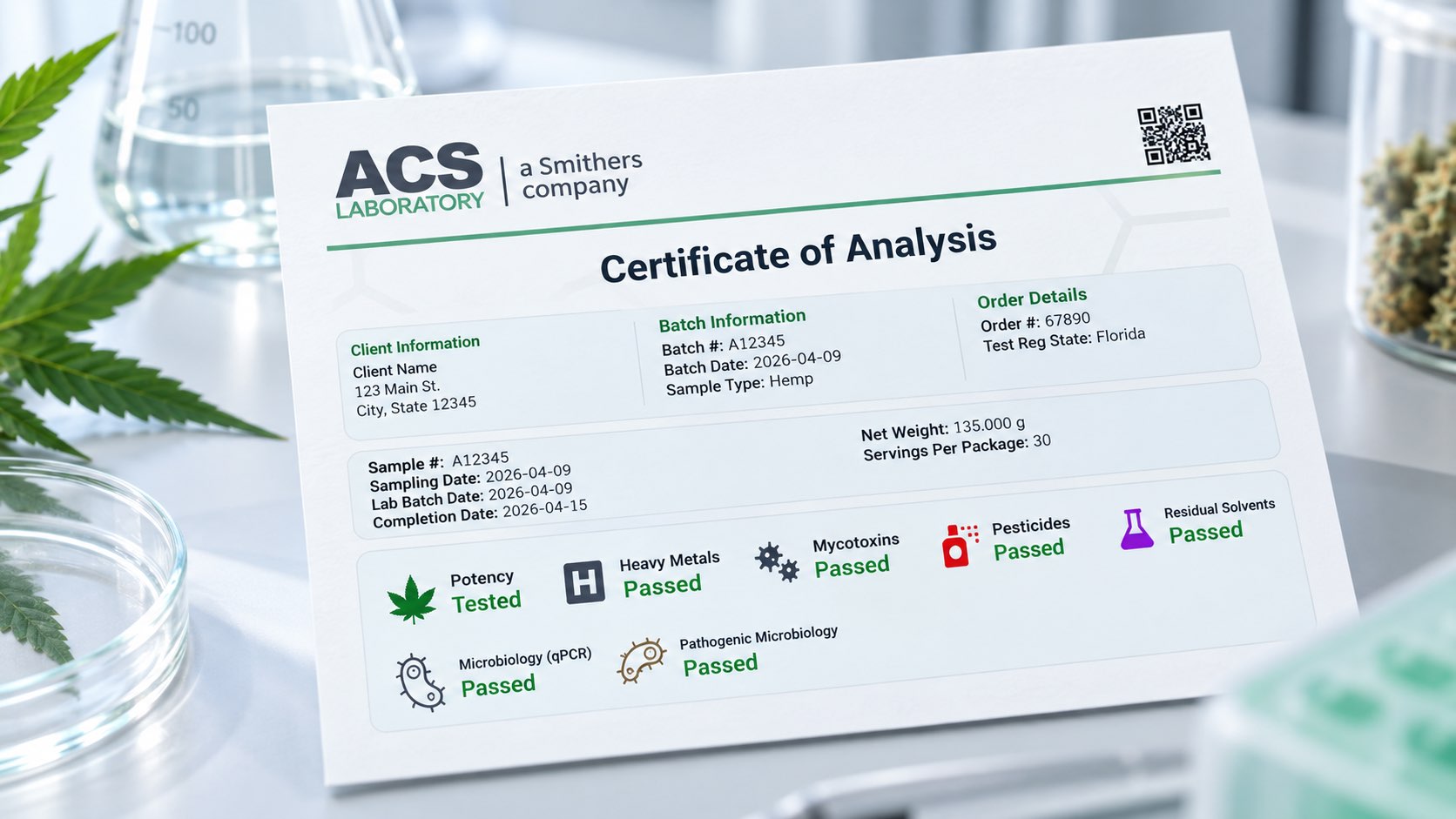
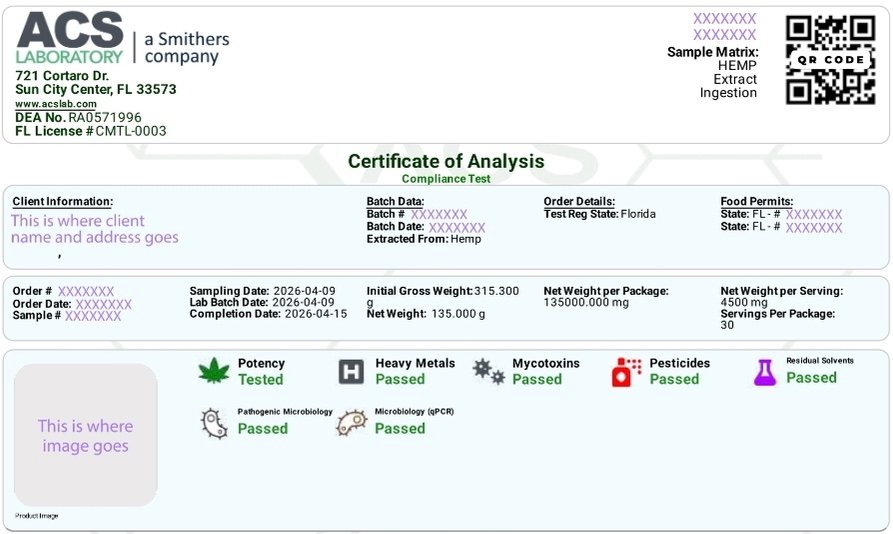
Image Credit: ACS Laboratory, a Smithers Company. Sample Florida Hemp Compliance COA
A Certificate of Analysis (COA) is a laboratory report showing the results of tests performed on a particular product. An independent third-party laboratory typically issues the document after analyzing a specific product sample.
A hemp COA can help verify product compliance, purity and label accuracy:
THC Compliance Information: A COA shows whether a product meets the federal hemp standard of no more than 0.3% delta-9 THC and provides results consumers can compare against additional state requirements. Some states set stricter THC limits or restrict specific cannabinoids, so consumers can use the cannabinoid results to identify compounds that may affect compliance.
Verification of Purity : A COA provides independent third-party laboratory results confirming that a product has been tested and is free of—or within acceptable limits for—harmful contaminants, including pesticides, pathogenic microbes (bacteria, yeast, mold), and heavy metals.
Label Accuracy: A COA shows measured cannabinoid levels, such as THC and CBD, so that consumers can compare the potency results with the amounts stated on the product label. This helps prevent issues like underlabeling (which poses impairment risks) or overlabeling (which leads to a lack of expected medical benefit).
Accessing the COA
Consumers can usually access a COA by scanning the QR code on the product label or visiting the brand’s website. The report should correspond to the specific batch or lot number printed on the product.
However, finding a COA is only the first step. Consumers still need to read the COA to confirm that the report is legitimate, that it matches their product, and that it includes sufficient testing to evaluate quality and compliance.
Why a COA Alone is Not Enough to Verify Results
A COA is only useful if the report matches the product and comes from a qualified laboratory. Unfortunately, some COAs are fraudulent or otherwise invalid for several reasons.
The COA could be fabricated or altered: Someone can create a false report or modify legitimate laboratory results.
The COA could belong to another batch: A brand may provide legitimate results that do not correspond to the product in hand.
The results could be outdated: Older results may represent a previous batch with different potency or contaminant levels.
The testing could be incomplete: A COA may report cannabinoid potency without testing for contaminants such as pesticides, heavy metals, or microbials.
The laboratory could use inadequate methods: Legitimate results can still provide a misleading picture if the laboratory lacks appropriate accreditation, validated methods, or sufficiently sensitive detection limits.
A few verification steps can help determine whether the report provides credible information.
How to Verify Results & Spot Fake COAs
You can verify a COA by checking details such as the batch number, laboratory credentials, testing scope, results, and test date. You can also compare the findings against the product label and applicable state testing requirements.
Follow these steps to get started:
1. Match the Batch Number or Sample ID
COAs contain batch numbers and sample IDs. A batch number identifies products made together, while a sample ID identifies the sample tested by the laboratory. Look for these numbers to confirm the COA applies to the product you purchased.
Check the package: Find the batch or lot number on the product label.
Check the COA: Find the corresponding batch or sample information on the report.
Compare them: The identifiers should correspond. A mismatch may mean the COA belongs to a different product or batch.
2. Confirm Lab Accreditation & State Certification
Check the COA for the name of the lab that tested the product before trusting the results. Look for ISO/IEC 17025 accreditation. Then check to ensure that the lab is registered to test hemp in your state, if applicable.
Look for ISO/IEC 17025 accreditation: This accreditation indicates that the laboratory meets international standards for technical competence and reliable testing. ACS Laboratory, for example, holds ISO/IEC 17025:2017 accreditation through A2LA.
Verify independence: Confirm that an independent third-party laboratory tested the product, not the manufacturer or brand itself.
Confirm that delta-9 THC does not exceed the federal limit of 0.3% on a dry-weight basis. Then check your state’s potency rules, which may impose additional THC limits or restrict specific intoxicating cannabinoids. These requirements vary significantly so that the same COA can indicate compliance in one state but not in another.
Colorado and Georgia are just two examples that show how different these rules can be:
Colorado:Colorado restricts intoxicating cannabinoids such as HHC, THC-O, and THCP in standard hemp products. Check the COA to confirm they do not contain these compounds.
Georgia:Georgia requires COAs to report delta-8 THC, delta-10 THC, exo-THC, THC-O, and HHC. Check the Lab Report to confirm that it quantifies these compounds.
4. Look for Incomplete Testing
Check whether the lab report contains a full panel of potency and purity tests. Some COAs only report THC levels, raising questions about potential contaminants.
84.9% provided a COA, yet 71.1% of those COAs did not report impurity testing, such as heavy metals or residual solvents.
These incomplete COAs do not provide reassurance about the product’s quality.
5. Check Contaminant Levels
When a COA includes contaminant testing, check that the results fall below the applicable limits for each substance tested. Substances include pesticides, heavy metals, residual solvents, microbials, and mycotoxins.
[Applicable limits are the maximum amounts of specific contaminants that regulators allow in a product.]
Check the status: Look for a clear “Pass” designation or results below the laboratory’s listed action limits. “ND” means the laboratory did not detect the substance at or above its stated detection threshold.
Compare state requirements: Some states set specific contaminant limits, while others require less comprehensive testing. Check your state’s rules when evaluating the results.
6. Ensure Test Results Match the Label Claims
Compare the COA results with the claims on the product label to verify the test results. A contradiction can signal inaccurate labeling or a COA that does not belong to that product.
For example:
If the label says…
Check the COA for…
"Delta-9 THC free"
Delta-9 THC reported as not detected
"CBD isolate"
CBD as the cannabinoid present, without other cannabinoids detected
"Full spectrum"
Multiple cannabinoids consistent with a full-spectrum hemp extract
"Pesticide free"
No detected pesticide residues
"Solventless" or "rosin"
No detected residual extraction solvents
"THC free"
No detected THC compounds included in the laboratory's cannabinoid panel
"Contains CBG"
CBG listed and detected in the cannabinoid results
7. Check the Test Date
Check the test date to determine whether the stated test results still provide a meaningful picture of the product. Older results may belong to a previous batch. Additionally, products can degrade over time. A COA from early in a product’s life may not reflect its potency or quality near the end of its shelf life.
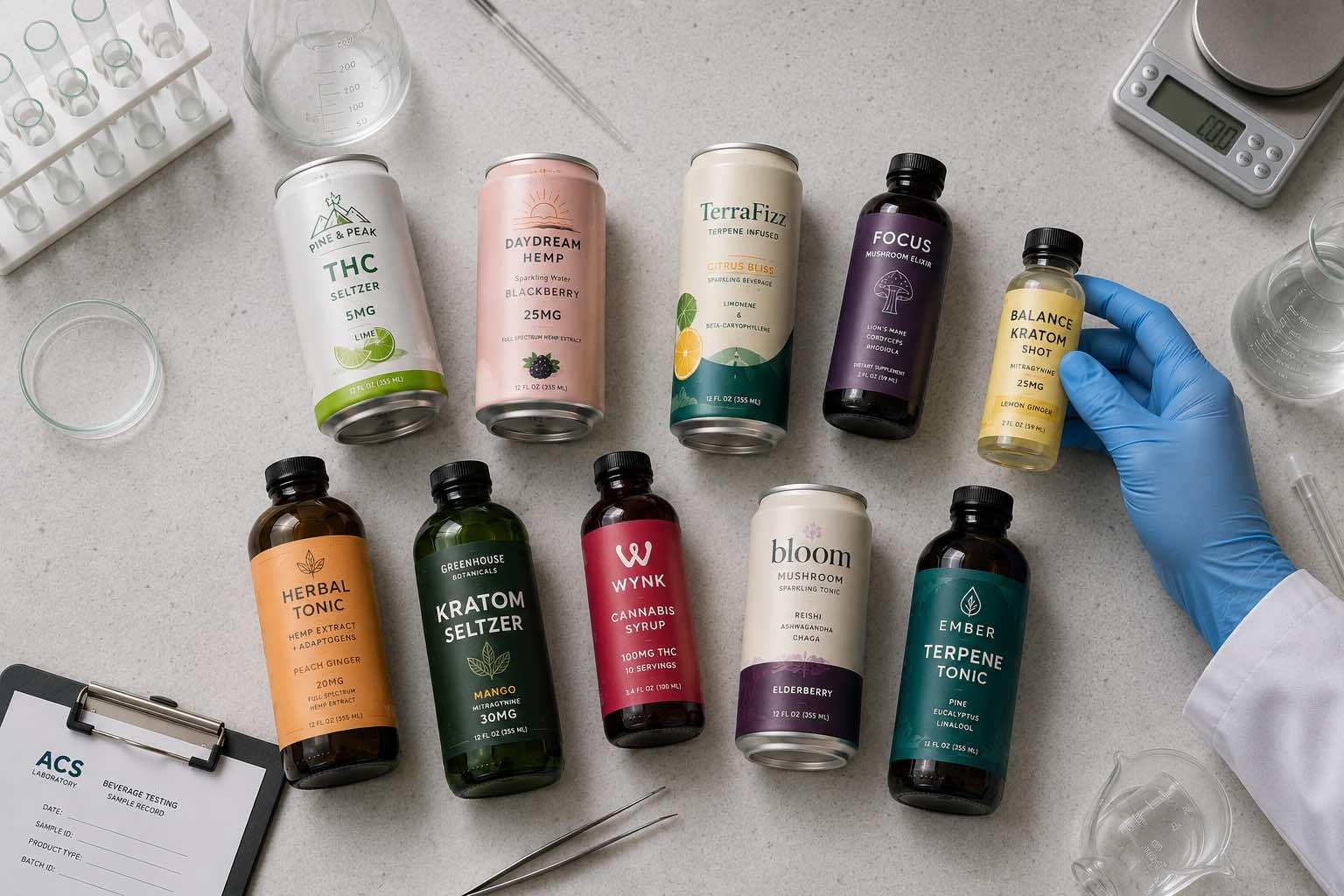
Aim for results from the past 12 months: Treat COAs older than one year as a reason to investigate further. Pay particular attention to infused beverages, whose cannabinoid potency can change in days with temperature, acidity, storage, and formulation affecting stability.
Ask for updated results: If the COA is outdated, predates the current batch, or raises shelf-life concerns, contact the brand for a more recent COA tied to the product in hand.
How to Verify Lab Reports in Minutes
You can verify the basics of a COA in about five minutes by checking a few details that are difficult to fake. Focus on whether the laboratory exists, its credentials check out, and the report connects directly to the product in hand.
Search for the laboratory independently. Search the laboratory name rather than following a link from the product brand. Confirm that the facility has a legitimate website, physical location, contact information, and testing credentials.
Verify the accreditation. Find the accreditation number on the COA and search for it through the accrediting organization’s database. Confirm that the accreditation is current and covers the types of testing shown on the report.
Match the product and COA. Compare the batch or lot number on the package with the identifying information on the COA. If they do not correspond, the results may not apply to that product.
Scan the report for full panel testing. Look beyond cannabinoid potency for contaminant panels such as pesticides, heavy metals, residual solvents, microbials, and mycotoxins. A COA that only reports potency leaves important questions unanswered.
Verify questionable results directly. Contact the laboratory using contact information found independently, not information supplied by the brand. Provide the COA’s sample or report number and ask the laboratory to confirm that it issued the report.
Have questions about a COA or need third-party testing for your hemp products? Contact ACS Laboratory to verify results or get your products tested.
Need a Test or Have a Question
Call Us at 813-670-9197 or Click to send us a message.













.png)

.png)
.png)
.png)
.png)